

Ready to begin your studio journey?
Launch your studio with a free trial of OfferingTree and start your journey off right. Build your website, offer classes, take payments, and so much more!
This post was written by Rachel Scott, yoga teacher, yoga education expert, and curriculum designer.
One of the first questions I get asked is, “How do I know if I’m ready to run a yoga teacher training?” This is a great question to ask because being ready and feeling ready are two different things. We almost never feel completely ready to try something new, but that doesn’t mean that we shouldn’t do it!
Launching a yoga teacher training is an exciting opportunity to share your passion for yoga with others, develop financial resilience, and step into your leadership. However, creating and running a yoga teacher training is very different from leading public classes. So what do you really need to know before you dive in? We’ll look at three different components to consider: readiness as a teacher, time expectations and developing curricula, pricing and the pros and cons of hybrid models.
Readiness as a teacher
Here are some good questions to ask before you jump in:
- Have I been teaching yoga long enough to have a clear sense of my own cuing and sequencing methodology?
- Can I communicate my teaching methodology?
- Can I read and foster positive group dynamics?

Let’s look at these points in more detail.
Teaching methodology: leading classes is different than educating
The skills required to be a great group class instructor are different from the skills that are required to be a great teacher trainer. As a group class instructor, you teach a class; as an educator, you teach others how to teach a class. Being a yoga educator means that you need to be able to articulate the “why” and “how” behind teaching skills such as cueing, demonstrating, assisting, and sequencing.
Communicating a teaching methodology
Not only do you need to be able to articulate our teaching methodology, you also need to be able to teach it to others. Supporting your trainees to become good teachers is about more than lecturing; you need to create guided activities and learning experiences to help them progressively develop and demonstrate these skills with excellence. Part of this process involves creating meaningful and specific assessment tools that help keep your students on track.
Facilitating group dynamics
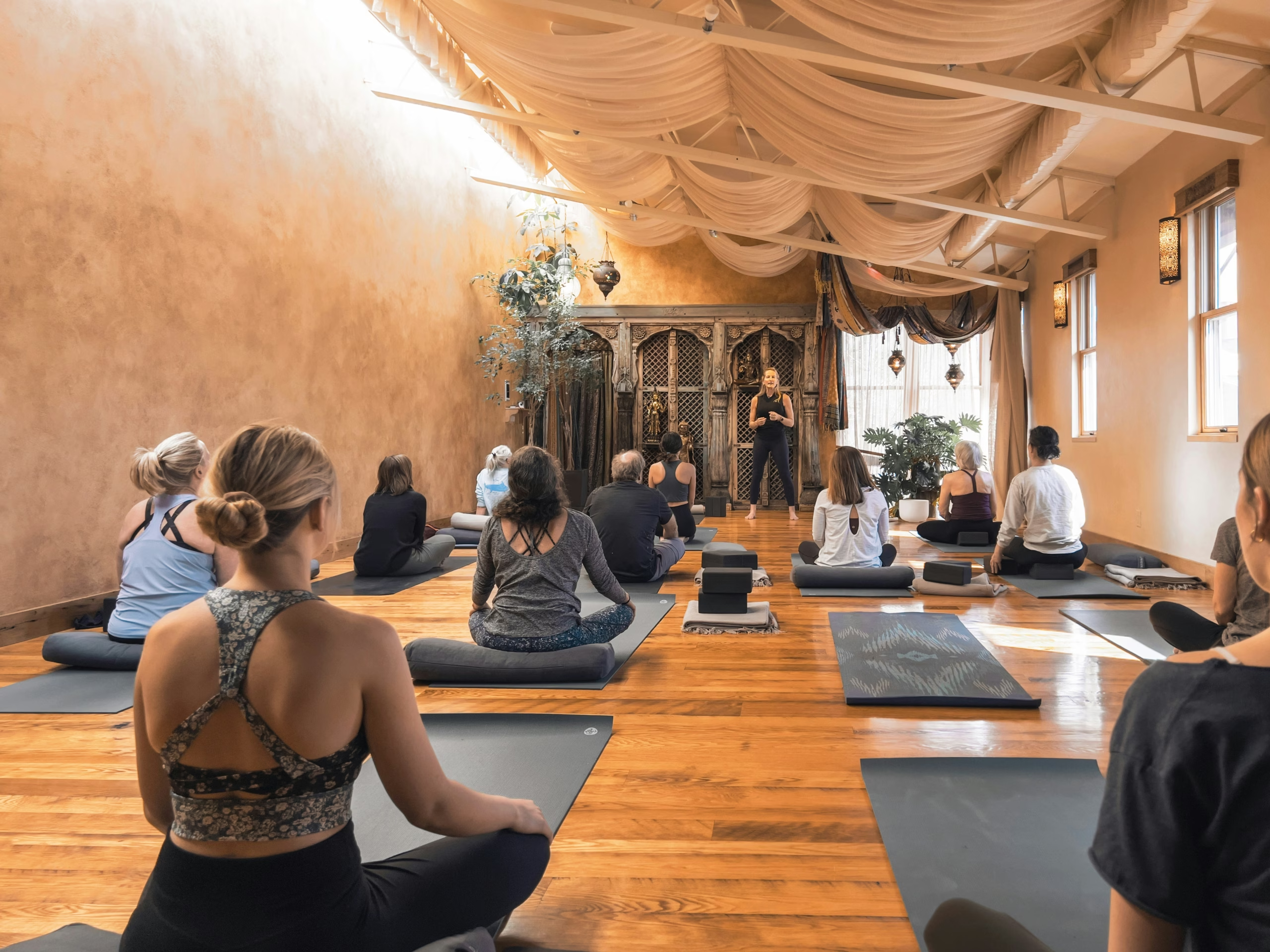
As group class instructors, we generally teach and others follow along without too much comment. However, as a teacher trainer, you will be managing group interactions and interpersonal dynamics constantly. Some students may feel insecure or shy, while others will be chatty and confident. You will need to adapt your coaching style to meet each student where she is at to help her excel. Many students find that teacher training is an opportunity for substantial personal growth. As a facilitator, you need to be ready to take on a leadership role that creates a safe, supported, and inclusive space for your students’ growth and vulnerability.
Creating your curriculum
If you have a sense of your own teaching methodology, then it’s time to look a little more closely at curriculum building.
Creating a 200-hour program takes literally hundreds of hours to do properly (you’ll spend at least 1-2 hours planning for every hour of the training, which is 200-400 hours minimum). In addition to lesson plans, you will have to create a student manual, meaningful assessments (practicums and exams) and a sensible program structure. If you are registering with an organization such as Yoga Alliance you will also have to ensure that your core competencies and hours requirements align with their standards.
One of the major mistakes new teacher trainers make is to think that their training is defined by what they – as the trainer – say or do. To that end, it’s tempting to start by creating the student manual. This isn’t a bad idea, after all, the student manual is the reference guide for your training. However, to really think like an instructional designer, it’s better to focus first on contemplating: “What do my students need to DO at the end of the training for me to know that they have succeeded?”

In other words, we need to start by defining the specific benchmarks for successful trainee performance, and then work backwards from there.
For example, you may consider:
- Does my trainee need to be able to create a sequence from scratch?
- Does my trainee need to give effective hands-on assists?
- What specifically do I need to see when they cue a pose in order to feel it’s been taught thoroughly and well?
By defining measurable standards for student performance, you will help avoid the sticky trap of thinking that the training is about what you (as the trainer) do or say. An effective training focuses instead on what your trainee can do or say.
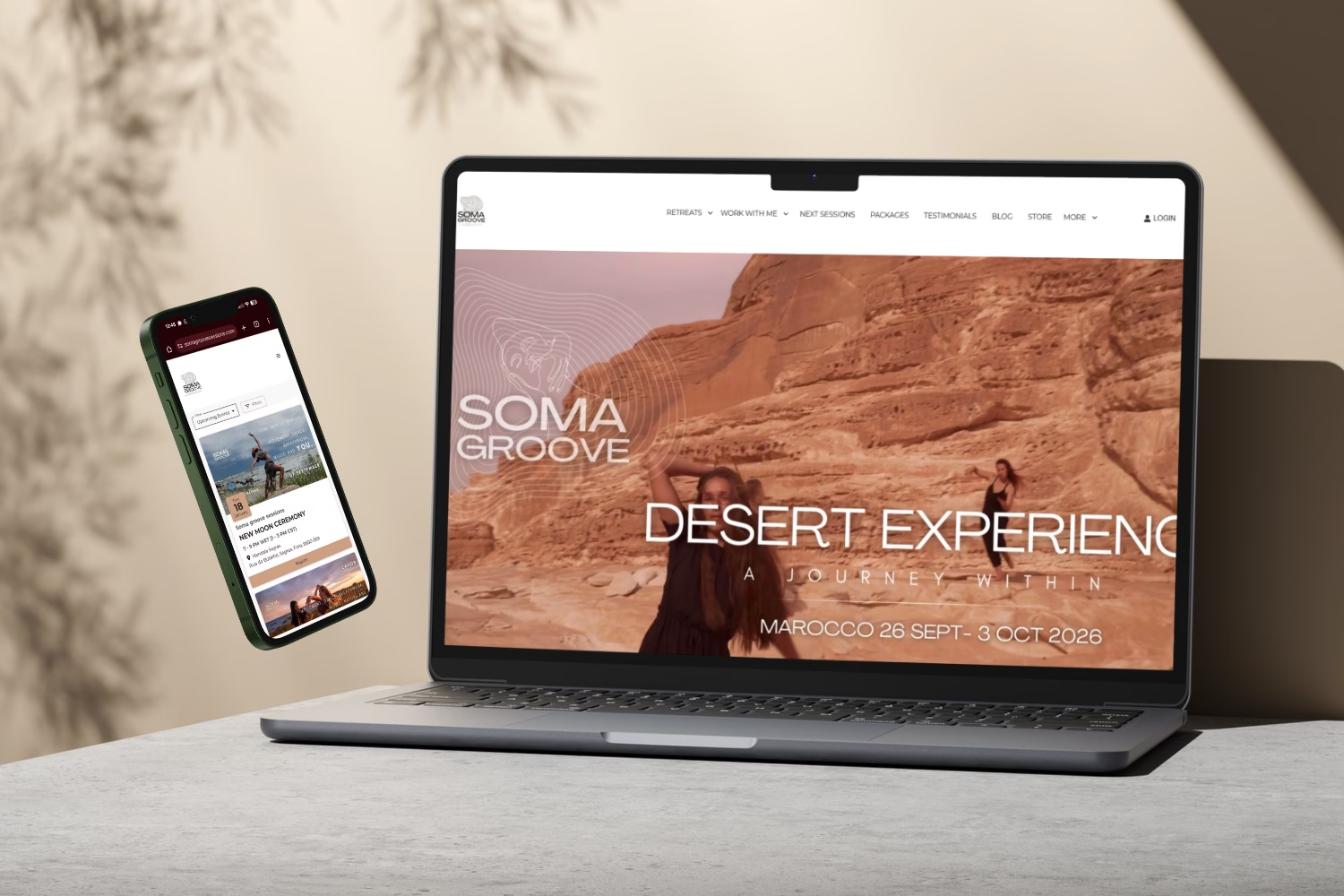
If you’re also thinking through the business side of running a training like registration, payments, course materials, OfferingTree’s course and program tools are worth a look. You can watch my free webinar on How to Host Your Online Courses on OfferingTree. Teachers like Julie at Bliss for EveryBody in Cleveland use it to manage the logistics of their YTT school alongside their regular class schedule.
When you should use a pre-made curriculum
If the idea of creating your own program from scratch feels overwhelming – or if you’re simply short on time due to the many demands of work, life and family – never fear! There are some great resources that can help you out. You may consider working with an instructional expert like me to help you outsource some of the substantial labor of program building (through purchasing lesson plans or a full program) or you can get targeted coaching to ensure that you are building your program efficiently.
Working with an appropriate pre-made curriculum may be an excellent idea. Working with professional materials can save you hundreds of hours of work and allow you to focus on editing/ refining rather than building from scratch. However, there are a few caveats. Before you invest in someone else’s curriculum, you need to ask the following questions:
- Most importantly: do I align with this curriculum’s teaching methodology (that is, how it teaches the students to cue and sequence)
- Is this material editable by me so that I can “make it my own?”
- Is the curriculum provider reputable, both as a teacher trainer as well as as an instructional designer?
- What kind of support will I get through this process?
I have known too many people who have invested in a curriculum and then come to me because that original curriculum was unstructured or poorly detailed. Asking questions up front will ensure that you are making the best decision for your school.
Pricing
As a rule of thumb, most 200 hour teacher trainings are priced between $15-$20/training hour per student, or between 3K and $3500 per student for the program. This pricing can vary depending on the experience of the trainers, the amount of online material, the amount of mentorship and coaching, and the demographics of the area. You have probably seen online 200 hour trainings that are ridiculously inexpensive (below $400), but these programs would likely include substantial asynchronous material, no in-person time, and limited coaching. I would not be influenced by these factors, but would encourage you to price your training at a benchmark that honors your work and investment.
Online and hybrid models
Since COVID, offering online components to teacher training has become far more common. We can divide “online” into two different formats: synchronous (like live on Zoom) and asynchronous (pre-recorded).

Offering some (or all) of your training online has the following advantages:
- Easier for students
- Allows you to include students from non-local areas
- Can be great for certain content (sequencing, philosophy etc.)
Disadvantages:
- Students can be easily distracted (checking email, tuning out)
- Certain content is harder or impossible to teach online (asana labs, partner work, hands on assists)
If you are interested in offering asynchronous content, there are also pros and cons.
Pros:
- Reduces classroom time
- Allows your students to work self-paced
- Can be great for content that bears re-watching
Cons:
- Can be very time consuming to do well (8 hours of work per every hour of content) if you are creating “self-contained” content that can stand alone (it’s less time consuming if you are creating reference materials that will then also be covered or tested in the classroom in person)
- If you want it to be “self-contained,” you will have to create assessments and ways to ensure that students have actually done the asynchronous work and that they understand it.
Using asynchronous material that a reputable educator has created can be a great way to get additional expert faculty in your training. For example, my partners at DoYogaWithMe offer anatomy and philosophy modules for other 200 hour teacher trainings that are self-contained. We use them in our own YTT and offer them to other schools for use. If you are looking to off-set some classroom hours, you can investigate and see if a provider may be right for you.
Final thoughts
One of the most important pieces of knowing if you are ready to lead a yoga teacher training? When you hear that voice deep inside that really wants you to do it! Leading a yoga teacher training is an unparalleled opportunity to challenge ourselves, step into our leadership, and participate in the lineage of this great tradition. If it feels a little scary–that’s normal! All great leaps forward must first embrace a little uncertainty.
If you’re feeling the call to lead a yoga teacher training, but aren’t sure where to start, reach out for some guidance! I’m always happy to have a free coffee chat 1:1 to brainstorm.
About Rachel
Rachel Scott supports yoga teachers and studios to create excellent teacher trainings and educational programs. With more than two decades of experience in the yoga industry, she specializes in bridging the gap between inspiration and effective teaching. Holding a Master of Science in Instructional Systems and Learning Technology from Florida State University, Rachel combines a deep understanding of how adults learn with thousands of hours or experience as a yoga educator. Her trainings blend modern educational design with the heart of yoga, giving teachers the tools to teach with clarity, authenticity, and purpose. Rachel is known for making complex topics like anatomy, philosophy, and pedagogy accessible and engaging, helping teachers translate knowledge into confident, inspired teaching.
Learn more at rachelyoga.com or meet her on the socials @rachelscottyoga.