

Ready to begin your studio journey?
Launch your studio with a free trial of OfferingTree and start your journey off right. Build your website, offer classes, take payments, and so much more!
You logged in to update one class price. Forty minutes later you’ve clicked through six menus, your booking widget is showing the wrong availability on your website, and you still haven’t found where the new tax setting lives. If this is a normal Tuesday morning, you’re not the problem. The software is.
WellnessLiving is a capable platform, but the price tag, the depth of the menu structure, and the per-feature add-ons stack up fast for studios that just want to teach classes and run a sustainable business. Looking at WellnessLiving’s published pricing, the BusinessPro plan runs $349 per month at the regular rate (at the time of writing there is a sale for 80% off your first two months), and that’s before branded apps, marketing add-ons, or on–demand functionality.
The good news: the market is full of WellnessLiving competitors now, and several of them are genuinely good. The catch is that “best” depends entirely on what you’re running. A solo Pilates teacher needs something very different from a 600-member CrossFit gym, and a yoga studio with three teachers sits somewhere in between.
This guide reviews 12 WellnessLiving alternatives with an eye on the things that actually matter when you’re shopping fitness management software: transparent pricing, ease of migration, whether the platform fits your business size, and how much it’s going to nickel-and-dime you once you’re in. We’ll cover the WellnessLiving competitors worth a real look, who each one fits best, and where to be cautious.
A note before we get into it: pricing on this kind of software changes often, and many platforms publish very little publicly. Where we couldn’t confirm a price on the company’s own website, we’ve noted that you’ll need to request a quote. Always double-check current pricing before you commit.
What to evaluate when comparing WellnessLiving alternatives
Before the list, here’s what to weigh as you read:
- Pricing transparency. Can you see the monthly cost on the website, or do you need to sit through a sales call first? Hidden pricing usually correlates with high pricing.
- Transaction and processing fees. A platform with a low base price can cost you more in the long run if it adds a percentage to every payment. Read the fine print on Stripe, Square, and proprietary processing.
- Migration support. If you’re switching from WellnessLiving, you have years of client data, schedules, and memberships to move. Find out who does the heavy lifting and what it costs.
- Business size fit. Solo trainers, boutique studios, and large gyms have completely different needs. A platform built for one will frustrate the other two.
- Contract terms. Month-to-month is your friend. Annual lock-ins look cheaper until the platform doesn’t work out.
Quick comparison: 12 WellnessLiving alternatives at a glance
| Platform | Best for | Starting price |
|---|---|---|
| OfferingTree | Independent wellness pros and small-to-mid studios who want everything in one place | $26/mo (Individual), $100/mo (Studio), annual billing |
| Glofox (ABC Glofox) | Boutique gyms and multi-modality studios that want branded apps | Quote based |
| Vagaro | Salons, spas, and mixed wellness businesses wanting low entry pricing | From $30/mo (on sale for $23.99/mo at time of this article) |
| Zen Planner | Gyms, martial arts schools, and CrossFit boxes | From $99/mo |
| Bookee | Small studios looking for mobile-first scheduling and payments | $149/mo |
| Pembee | Group-activity businesses that want core scheduling without the bloat | $45/mo (Standard) |
| Gym Insight | Gyms that want to use their own merchant account | Quote based |
| Exercise.com | Multi-location gyms and personal trainers needing custom builds | Quote based |
| Omnify | Course and reservation-based businesses wanting straightforward booking | From $49/mo |
| RhinoFit | Budget-minded gym owners | $57/mo; a free start-up tier exists for very small operators |
| SimplyBook.me | Solo practitioners and microbusinesses needing lightweight scheduling | Free plan; paid plans from around $11.90/mo (annual) |
| Acuity Scheduling | Independent coaches and trainers who mostly take one-on-one appointments | Emerging $16/mo (annual) |
| Appointy | Startups and small studios wanting a free entry point | Free plan; paid plans from $19.99/mo |
Now let’s get into each one.
1. OfferingTree
Best for: Independent wellness professionals and small-to-mid studios who want everything in one place without surprise charges.
Starting price: Individual plans from $26/month (annual billing); Studio plans from $100/month (Individual pricing | Studio pricing).
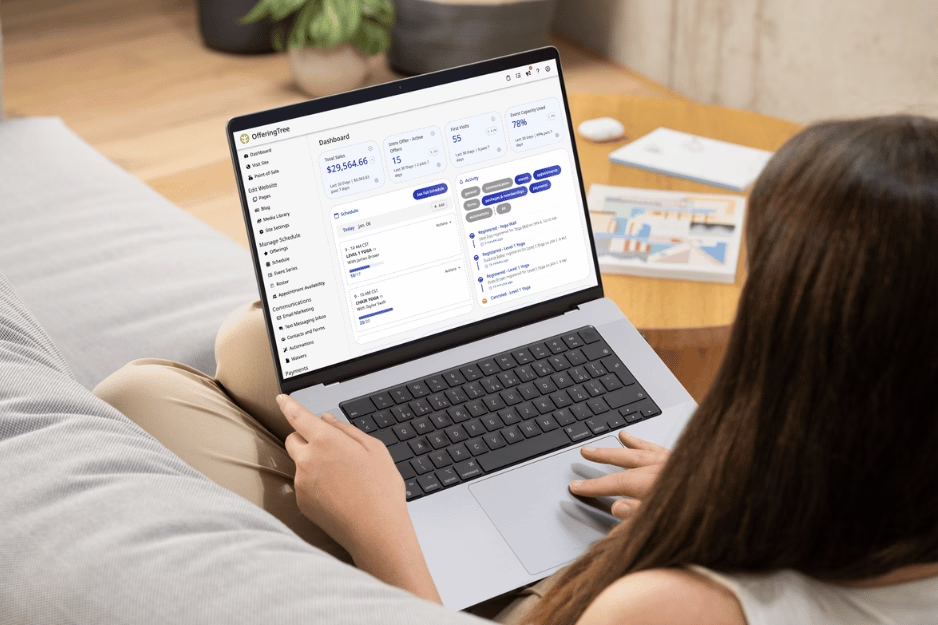
OfferingTree was built by wellness professionals who couldn’t find software that respected their actual workflow, and that origin shows up in how the platform feels day to day. It pulls scheduling, payments through Stripe, a website builder, email marketing, SMS, unlimited on-demand video, and client management into a single platform, so you’re not juggling three logins to send a class reminder.
A few specifics worth calling out:
- Pricing is published. What’s on the pricing page is what you pay. Compared with WellnessLiving’s listed BusinessPro at $349/month, the Studio plan range of $100 to $225/month is meaningfully different.
- 0% transaction fees on most plans. The Pro, Pro Plus, and all Studio plans charge no platform transaction fee on top of standard Stripe processing. (The Essentials tier does include a 2.9% platform fee, so pick the right plan for your volume.)
- Free migration with most plans. Switching from WellnessLiving means moving client records, memberships, and recurring payments. OfferingTree handles that for you and pairs you with onboarding support.
- Built for wellness, not retrofitted. The platform supports yoga studios, Pilates studios, fitness instructors, and wellness coaches with templates and workflows for each. If you’re a yoga studio specifically, the templates and class types are already there.
What you’d give up versus a platform like WellnessLiving: OfferingTree doesn’t run a marketplace, so you won’t be discoverable through a giant consumer-facing app. For most studio owners that’s a feature. There’s a free trial available so you can test the platform on real data before committing.
2. Glofox (ABC Glofox)
Best for: Boutique gyms and multi-modality studios that want a branded member app.
Starting price: Quote based. Glofox doesn’t publish pricing on its website; you’ll need to request a quote.
Glofox (now ABC Glofox after the ABC Fitness acquisition) is built around the boutique gym and studio market. Core features include member check-in, class scheduling, memberships, payment processing, reporting, and a separate staff app. The white-label branded app is the headline differentiator. Clients book, track progress, and engage with your brand instead of the platform’s.
Glofox sits on the higher end of the market, which is justified if you’re scaling and need the branded app and CRM tools. It’s a much heavier solution than most solo practitioners need, and you’ll need to request a quote to see real numbers.
3. Vagaro
Best for: Salons, spas, and mixed wellness businesses looking for low entry pricing and point of sale (POS) features.
Starting price: From $30/mo (on sale for $23.99/mo at time of this article)
Vagaro has been around long enough to get the fundamentals right. It covers scheduling, payment processing, class management, payroll, and inventory in one place, with strong POS capabilities that suit appointment-based businesses like salons and spas alongside wellness providers. Point of sale, or POS, is the system you use to ring up a sale and track inventory in one motion.
The trade-off: Vagaro is broad, not deep on the wellness side. The base plan starts low but costs add up as you pay per bookable calendar, per add-on, and per integration. Price it out at your actual scale, not the headline number.
4. Zen Planner
Best for: Gyms, martial arts schools, and CrossFit boxes that run on recurring memberships.
Starting price: From $99/month, scaling by active member count
Zen Planner is built specifically for membership-driven fitness businesses where automated billing matters more than appointment booking. Automated billing handles recurring membership payments and renewals without you chasing payments manually each month.
Strengths include reporting depth and member engagement tools. Pricing scales with active member count, which is either a feature or a frustration depending on how predictable your roster is. It’s not the right fit for studios that primarily run drop-in classes or appointment-based services.
5. Bookee
Best for: Small studios looking for mobile-first scheduling and payments.
Starting price: $149/mo
Bookee positions itself as a streamlined booking platform with a mobile app focus, aimed at smaller studios that don’t need the depth of a Mindbody or WellnessLiving. The pitch is simple class scheduling, payments, and a member-facing app at a price point suited to independent studios and startups. Price it alongside two or three other options and pay close attention to what’s included in the base versus what counts as an add-on, particularly the branded app.
6. Pembee
Best for: Group-activity businesses that want core scheduling and payments without feature bloat.
Starting price: Standard plan at $45/month
Pembee is deliberately narrow. The team has built a focused product for studios and group-activity businesses that need scheduling, payments through Stripe, and a clean booking experience, then stopped there. If you’ve ever switched away from a platform because you were paying for fifty features you never used, that focus is the appeal. Feature bloat, in case it’s a new phrase, is what happens when software keeps adding capabilities to justify higher prices until the product is impossibly complex for the 80% of users who only need a few things to work well.
Pembee’s pricing is published clearly on its site, which is increasingly rare in this category, and it is priced a bit lower to match the capabilities. The 0.59% application fee is on top of standard Stripe fees, so do the math against your monthly transaction volume.

7. Gym Insight
Best for: Gym owners who want to bring their own merchant account and avoid percentage-based transaction fees.
Starting price: Quote based.
Gym Insight markets itself as “built by gym owners for gym owners,” and one of its more distinctive features is letting you bring your own merchant account rather than locking you into a proprietary processor. For operators who’ve negotiated good processing rates elsewhere, this can be a meaningful saving.
The platform handles member management, billing, scheduled payments, access control, and detailed reporting. It also offers data migration services from WellnessLiving. Worth a look if you’re a single-location or growing multi-location gym that wants granular control over billing and payment processing.
8. Exercise.com
Best for: Multi-location gyms, personal trainers, and fitness businesses that need heavy customization.
Starting price: Quote based.
Exercise.com is positioned as an enterprise-grade fitness business platform, with broad coverage across programming, payments, e-commerce, and integrations. It’s pitched as a custom-built solution rather than off-the-shelf, which means it can do more than most platforms here but also costs more and takes longer to implement. If you’re running a single yoga studio with three teachers, this is overkill. If you’re operating multiple locations, building custom workouts, or selling supplements alongside coaching, it’s worth a conversation.
9. Omnify
Best for: Course and reservation-based businesses wanting straightforward booking software.
Starting price: $49/month
Omnify focuses on online booking and scheduling for businesses that run courses, workshops, classes, or appointments. It’s particularly common with operators running hybrid or remote wellness offerings, given its flexible booking flows. Where Omnify earns its place on a WellnessLiving alternatives list is simplicity. If your business model is built around courses or session-based bookings rather than memberships, it’s worth comparing against the more gym-centric platforms above.
10. RhinoFit
Best for: Budget-minded gym owners running smaller operations.
Starting price: $57/mo; a free start-up tier exists for very small operators
RhinoFit is a no-frills gym management platform with POS, inventory support, and access control. The Start-Up tier at zero cost is genuinely useful for new gyms testing the water, with a clear upgrade path as you grow. Just be aware that the more interesting configurations (24/7 door access via DAC hardware, multi-location setups) involve hardware costs and longer-term commitments, so read the pricing page carefully.
11. SimplyBook.me
Best for: Solo practitioners and microbusinesses needing lightweight appointment scheduling.
Starting price: Free plan available; paid plans from around $11.90/month (Basic, billed annually)
SimplyBook.me is appointment-first rather than gym-first. It handles online booking, calendars, custom features, and payment integration well, but it’s not built for membership management or class-pack billing the way fitness-focused platforms are. For a yoga teacher running a small list of one-on-one privates, or a holistic practitioner offering 60-minute sessions, the free tier is enough to test the workflow. If you grow into running group classes and memberships, you’ll likely outgrow SimplyBook.me and want to move to a fitness-specific platform.
12. Acuity Scheduling
Best for: Independent coaches, trainers, and solo practitioners focused on one-on-one appointments.
Starting price: Emerging plan at $16/month (billed annually)
Acuity is the scheduling tool of choice for a lot of independent coaches and trainers. It’s clean, integrates well with Google and other calendars, syncs payments, and handles intake forms and reminders without much setup time. What it isn’t: a fitness management platform. There’s no membership module that competes with the dedicated tools above, no class-pack tracking the way a studio platform handles it, and no built-in marketing the way OfferingTree or Vagaro offer. For solo work, that simplicity is the point. For a studio with more active members, it isn’t enough.
Bonus: Appointy
Best for: Startups and small studios that want a no-cost entry point.
Starting price: Free plan available; paid plans start at $19.99/month (Growth)
Appointy is a generalist appointment scheduling platform with a free tier and several paid tiers. It’s worth a look if you want to test scheduling software without any spend, but be prepared to outgrow it if your studio scales past appointment-style bookings. The free plan has clear limits on staff count, services, and monthly appointments, so check those numbers against your actual volume before assuming it’ll cover you.

How to choose the right WellnessLiving alternative for your business
A useful exercise before you sign anything: write down the three things WellnessLiving does that you’d want a new platform to do better. Maybe it’s pricing. Maybe it’s the load time. Maybe it’s that your members can’t find the booking page on their phones. Whatever those three things are, screen alternatives against them first.
Then layer in business size:
- Solo practitioners and microbusinesses are usually best served by simpler, lower-cost tools like SimplyBook.me, Acuity, or OfferingTree’s Individual plans.
- Small-to-mid studios (1 to 10 teachers, mixed class and appointment booking) tend to do well with OfferingTree’s Studio plans, Vagaro, or Pembee, depending on whether they want a full marketing suite or just core scheduling and payments.
- Gyms and martial arts schools built on memberships should look at Zen Planner, Gym Insight, or OfferingTree’s Studio plans.
- Multi-location operations with serious customization needs are the natural fit for Exercise.com, OfferingTree, or Glofox.
Two things are worth checking on every shortlist: whether there’s a free trial (so you can run a real test with your data) and what migration looks like (so you’re not stuck doing the work yourself on launch day).
Frequently asked questions
What features should a fitness business prioritize when choosing WellnessLiving alternatives?
Start with the core: class scheduling, appointment management, payment processing, client records, and reporting. Then layer in what your business actually needs on top. Boutique studios often want branded client apps and marketing automation. Gyms tend to prioritize membership billing and access control. Solo practitioners benefit most from clean appointment workflows.
Onboarding matters too. That’s the process a platform uses to help you migrate your data and get up and running, and the difference between a good onboarding experience and a bad one is often the difference between launching in a week versus a month.
A simple rule: make a “must have” list and a “nice to have” list before you start demoing. It’s the cheapest way to avoid buying features you’ll never use.
How do pricing and payment processing affect the real cost of fitness management software?
The base plan is only part of the picture. Total cost of ownership includes the monthly subscription, transaction or platform fees on every payment, processing fees from Stripe or Square, branded app fees if you need one, and add-ons for marketing, SMS, or extra staff seats. A platform with a $40/month base plan and a 2% transaction fee can easily cost more than a $100/month plan with 0% transaction fees once your monthly revenue is sizable. Run the math on your actual numbers before falling in love with a low headline price.
Pricing transparency is also a signal. Platforms that publish their numbers tend to charge consistent rates. Platforms that hide pricing behind sales calls often price based on what they think you’ll pay.
What’s the difference between alternatives for small studios versus large gyms?
Small studios usually need fewer features, simpler workflows, and lower price points. Tools like Bookee, Appointy, SimplyBook.me, and OfferingTree’s Individual plans tend to fit best here.
Large gyms need more: memberships at scale, access control, multi-location reporting, integrations with point-of-sale hardware, and the ability to handle thousands of clients without slowing down. Glofox, Exercise.com, Zen Planner, and OfferingTree’s higher Studio plans are usually the better fit.
The mistake to avoid: buying a platform built for one business size when you actually run another. A solo trainer using a 600-member gym platform will spend half their time hiding features they don’t need. A growing studio using a basic scheduler will hit walls within a year.
How important are onboarding and data migration when switching from WellnessLiving?
Critical. If you’re moving away from WellnessLiving, you have years of client records, class history, payment data, and active memberships to move. Platforms that handle migration well, like OfferingTree (free with most plans) or Gym Insight, save you days or weeks of work. The ones that hand you a CSV export and wish you luck cost you a lot more than they look like on the price page. Data migration just means the secure transfer of records from your old system to your new one, ideally without losing anything or duplicating anything. Ask specifically: who moves the data, what’s included, how long does it take, and what happens if something goes wrong. The answers should be specific, not vague.
Are branded client apps and marketing automation really necessary?
It depends on your business model and your growth stage. A branded client app is your studio’s own version of the booking app, rather than a generic platform app. It helps with member retention because it puts your brand on the home screen and makes booking feel native to your business. It matters more for boutique studios where brand is a real differentiator and less for small operations where word of mouth does most of the work.
Marketing automation, meaning automated emails, SMS reminders, and lead-nurture sequences, saves time and lifts conversion rates if you have a steady flow of leads. For brand-new studios with low lead volume, it’s a “nice to have.” For studios past their first year with a list of past clients to win back, it tends to pay for itself. If your current platform doesn’t offer either and your business is growing, it’s worth pricing both into your decision.
Ready to see how OfferingTree compares?
If you’re weighing WellnessLiving alternatives and want to see what a transparent, all-in-one platform looks like for your business, start a free trial of OfferingTree and run it on your real data. Or book a demo and walk through the platform with someone who can answer your questions directly. No long sales cycle, no quote-only pricing, no surprises on the invoice.