
How to set goals for wellness professionals
Are you overcommitted or just “busy”? Discover how to flip the goal-setting model by calculating your true capacity before setting milestones. Practical advice for wellness pros from coach Amanda McKinney.

CONTENT:
- Why Traditional Goal-Setting Doesn’t Always Work
- Understanding the Performance Equation
- Goals vs. Milestones
- How to Calculate Your Capacity (The Right Way)
- What to Do When Life Throws You Off Track
- The Danger of Labels and Limits
- The Number One Barrier Isn’t What You Think
- Practical Application for Wellness Professionals
- Taking Action
This article includes insights from Amanda McKinney, host of the Accountable podcast and business coach for women entrepreneurs, shared in a recent OfferingTree webinar.
As wellness professionals, we’re no strangers to goal setting. Whether you’re planning to launch a new program, grow your email list, or finally write that book, you’ve probably experienced the frustration of setting an ambitious goal only to fall short. But what if the problem isn’t your commitment or capability? What if you’ve simply been taught to set goals backwards?
According to entrepreneur and accountability coach Amanda McKinney, who led a webinar on this exact topic for the OfferingTree community, most of us have been conditioned to approach goal setting in a way that actually sets us up for failure. The solution? Flip the model entirely by calculating your capacity before setting your milestones.
Why traditional goal-setting doesn’t always work
Here’s what typically happens: You decide on a goal (let’s say launching a new wellness program), pick a timeline (90 days sounds good!), grab some colorful sticky notes, and start mapping out your plan on the calendar. You’re excited, motivated, and ready to crush it.
Fast forward a few weeks, and reality hits. Client sessions run long, family obligations pop up, you get sick for a week, and suddenly that 90-day plan is crumbling. You feel like you’ve failed again, adding to a growing pile of unmet goals that chips away at your confidence.
Sound familiar?
The problem, Amanda explains, isn’t your work ethic or dedication. It’s that you set the milestone first and hoped your schedule would accommodate it, rather than looking at your actual available time and setting a realistic milestone based on that capacity.
“We think, ‘Here’s the milestone that I want to hit,’ and then we put it on the calendar,” Amanda noted. “We’re missing a step in between. What we have to do is actually calculate our capacity first and then set the milestone.”
Understanding the performance equation
Amanda’s approach is grounded in the 1982 Blumberg Model of Performance, which states that performance is a function of three elements: opportunity, capacity, and willingness. While opportunity and willingness matter, capacity is where most wellness professionals stumble.
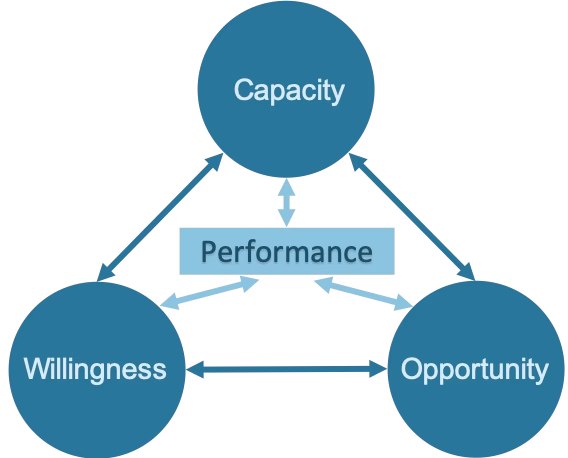
Source: People Shift
Capacity includes four key components:
- Time: Hours available to dedicate to your goal
- Energy: Mental and physical bandwidth to pursue it
- Finances: Resources needed to support it
- Skills and Knowledge: Expertise required or ability to learn
For the purposes of practical goal setting, Amanda focuses primarily on time because it’s the most concrete element to measure and the one we’re typically least honest about.
The critical distinction: goals vs. milestones
Before diving into the capacity calculation, it’s important to understand Amanda’s terminology. The big dream (writing a book, opening a second studio location, building a thriving online practice) is your goal. You don’t need to know every step to get there yet.

Source: Visual Thinking
Milestones are the specific, measurable steps that move you closer to that goal. These are where you need to be ruthlessly realistic.
As Amanda puts it: “Be optimistic about the big stuff. Be so excited. You don’t have to know all the answers, but if you want to eventually get to the big thing that you want to do, you have to be realistic about that first step, that second step, that third step.”
A powerful video Amanda shared during the webinar illustrates this perfectly. A coach sets up pieces of paper as stepping stones across a room and asks a child to reach him for a high five without touching the floor. It’s easy when all the steps are in place. But as the coach removes papers, it becomes harder, and eventually impossible when all the stepping stones are gone.
The lesson? You can’t leap from where you are today to your big goal in one jump. You need those intermediate steps, and they need to be realistic.
How to calculate your capacity (the right way)
Amanda outlines a step-by-step process for calculating your true capacity, using a 90-day timeframe as an example (though this works for any period).

Step 1: Identify your goal-specific hours
This is not your total work time. If you’re a massage therapist who works 40 hours a week but wants to write a book, those 40 hours are already dedicated to running your existing business. The question becomes: How many hours per week can you dedicate specifically to writing?
“Please don’t compare yourself to other people,” Amanda emphasized. “They are dealing with different things in their life. Focus and be honest about your number of hours.”
Step 2: Choose your timeline
Ninety days works well because our brains naturally think in quarterly chunks that align with seasons. However, you can apply this system to any timeframe.
Step 3: Subtract full days off
This is where reality starts to reshape your timeline. Amanda uses summer as an example because it throws most business owners off with vacations, different schedules, and irregular routines.
Example 1: Full-Time Business Owner
- Start with 90 days
- Subtract 14 days for a two-week vacation = 76 days
- Subtract 25 weekend days (if you don’t work weekends) = 51 days
- Your actual working timeline: 51 days, not 90
Example 2: Side Hustle
- Start with 90 days
- Subtract 14 days for vacation = 76 days
- Subtract 61 days (working full-time elsewhere, only available on weekends) = 29 days
- Your actual working timeline: 29 days, not 90
Already you can see how dramatically different your capacity is from that initial 90-day assumption.
Step 4: Account for partial days
Life doesn’t operate in neat, full-day blocks. You have appointments, school pickups, lunch meetings, and unexpected interruptions.
Amanda offers two approaches:
Structured Approach: If you know you’re the carpool parent and afternoons are wiped out in late August when school starts, mark those as half days. This might reduce your 51 days to 44.5 days.
Estimation Approach: If your schedule is less predictable, subtract 10% for life’s curveballs. This builds in flexibility for the appointments and obligations that will inevitably arise.
“The key here is to not plan for the ideal schedule, but plan for your realistic schedule as much as possible,” Amanda advised.
Step 5: Calculate total hours (with buffer)
Now comes the math. Let’s say you determined you can work:
- 5 days per week (though Amanda notes this is rarely realistic for goal pursuit)
- 5 hours per day dedicated to this specific goal
- Over 12 weeks (90 days)
That gives you 300 hours or 60 days of work time.
But here’s Amanda’s secret weapon: Add a 20% buffer. Life will throw curveballs. Someone will get sick. A crisis will emerge. By planning for only 80% of your calculated capacity (240 hours or 48 days in this example), you create breathing room that prevents total derailment when the unexpected happens.
Step 6: Set your realistic milestone
Armed with your true capacity number, ask yourself: “What can I realistically do in 48 days to get me one step closer to my big goal?”
Notice how different this question feels compared to “What do I want to achieve in 90 days?”
Amanda offers a free capacity calculator that does the math for you, so you can focus on being honest about the inputs rather than crunching numbers.
What to do when life throws you off track
Even with the most realistic planning, life happens. A family member goes to the hospital. You get sick. Your motivation tanks. A client crisis demands your attention. How do you recover without spiraling into that familiar feeling of failure?
Amanda’s answer is both simple and profound: Forgive yourself.
“One of the best ways to get back on track is to acknowledge what happened and forgive yourself,” she explained. “Recognize that your priority shifted, and that’s okay. Then reassess your capacity and reset that milestone.”
This is crucial: If you’re halfway through your quarter and realize you won’t hit your milestone, don’t abandon ship. Recalculate your remaining capacity and set a new milestone for the time you actually have left. Getting to 75% of your original goal is far better than giving up at 25% because you couldn’t reach 100%.
The danger of labels and limits
One of the most powerful insights Amanda shared addresses the stories we tell ourselves about our goal-setting abilities.
“Labels can become limits if we let them,” she cautioned. “You are not a procrastinator. You may have a habit of procrastinating, but you are an amazing human that hit a bump.”
This distinction matters. When you label yourself as someone who “never finishes what they start” or “always fails at goals,” you’re creating a self-fulfilling prophecy. Instead, recognize that you’ve had setbacks (everyone does) and that with a more realistic approach, you can move forward.
The number one barrier isn’t what you think
After working with hundreds of clients and analyzing the data, Amanda discovered something surprising: The number one barrier to achieving goals isn’t time. It’s overcommitment.
“Most people would say, ‘It’s time,'” she noted. “No, it’s not. Everyone calls it time, but it’s overcommitment. You have overcommitted the time that you have, and we have to take ownership.”
This is why calculating capacity first is so critical. When you’re honest about your available time upfront, you stop overcommitting and start making real progress.
Practical application for wellness professionals
Let’s bring this home with a realistic example for a yoga teacher or wellness practitioner.
Big Goal: Launch an online membership program
Reality Check:
- You teach 12 classes per week
- You have 3 private clients
- You handle your own admin and marketing
- You want to maintain work-life balance
- You can realistically dedicate 3 hours per week to this new project
Capacity Calculation (90-day quarter):
- Start with 90 days
- Subtract 8 weekend days (teaching workshops) = 82 days
- Subtract 1 week vacation = 75 days
- Account for 10% buffer for life = 67.5 days
- At 3 hours per week = approximately 36 hours total
Realistic Milestone: In 36 hours, what’s achievable? Perhaps:
- Research 3 membership platforms and choose one (6 hours)
- Outline your first month of content (8 hours)
- Create your sales page (10 hours)
- Record your welcome video and first week of content (12 hours)
This is dramatically different from “Launch a full membership program in 90 days” when you’re simultaneously running your existing business. But it’s achievable, and success here builds momentum for the next milestone.
When you don’t know the next step
Sometimes the path forward isn’t clear. What if you don’t know what milestone to set because you’ve never done this before?
Amanda’s answer: “Figuring out the path is the milestone.”
If you have four hours over the next month, you might allocate:
- Week 1: Clarify what you want to do and why (journaling and reflection)
- Week 2: Brainstorm possible approaches (research and ideation)
- Week 3: Choose one path forward (decision-making)
- Week 4: Create the plan for your next milestone (strategy)
Your subconscious will work on these questions between sessions, and by the end of the month, you’ll have clarity and a realistic next step.
The permission to let goals go
Here’s something wellness professionals often need to hear: Not every goal needs to be pursued.
If you keep setting a goal and never making progress, Amanda suggests asking yourself: “Why is this important to me?” If the honest answer is “I feel like I should” rather than “I deeply want to,” you have permission to let it go.
“Goals change,” Amanda reminded the audience. “My business has evolved in the seven years that I’ve been an entrepreneur. Imagine if I had just hung on so tightly to the first thing I did as a business owner. I wouldn’t be as happy as I am now.”
On the flip side, if something truly matters to you, commit to it even when it’s hard.
“Most of the time what we’re looking for is confidence before the action, or excitement before the action. That’s just not realistic. It’s going to be hard, so force yourself to do it, even if it’s a smaller amount of time.”
Moving forward with realistic optimism
The beauty of Amanda’s approach is that it allows you to be wildly optimistic about your big dreams while remaining grounded in reality about the steps to get there. You can dream of writing a bestselling book while honestly acknowledging that this quarter, you have 30 hours to dedicate to it. That might mean your milestone is completing three chapters rather than the entire manuscript.
And that’s not just okay; it’s strategic. Because when you hit that three-chapter milestone, you build evidence that you can do this. You gain momentum. You prove to yourself that you’re someone who follows through. Then you calculate capacity for next quarter and set the next realistic milestone.
Over time, those milestones add up. The book gets written. The membership program launches. The studio expands. Not through magical leaps, but through honest, realistic, achievable steps.
As Amanda powerfully stated: “You can do it all, but you can’t do it at the same time. We have to be realistic about what we can actually achieve within a timeframe.”
Taking action
Ready to try this approach? Here’s your action plan:
- Download Amanda’s free capacity calculator to eliminate the math and focus on honest self-assessment
- Identify your big goal (the dream that excites you, even if you don’t know all the steps)
- Calculate your capacity using the process outlined above
- Set one realistic milestone based on your actual available time
- Build systems to support your progress with tools designed for wellness professionals, like OfferingTree’s all-in-one platform for managing your business operations efficiently
- Forgive yourself when you get off track, reassess your capacity, and set a new milestone
Remember: This isn’t about lowering your ambitions. It’s about honoring your reality so you can actually achieve those ambitions instead of perpetually falling short and feeling like a failure.
The stepping stones are there. You just need to place them at realistic intervals.
Amanda McKinney is an entrepreneur, accountability coach, and author who helps service-based business owners achieve their goals through realistic planning and sustainable action. Check out her podcast, Accountable. Learn more at amandamckinney.com.
This article is based on a webinar hosted by OfferingTree. For more resources on building a successful wellness business, explore the OfferingTree blog and join the Studio Community for ongoing support and education.
See OfferingTree in action
Scheduling, payments, your website and email marketing in one place, built for wellness businesses.
Start a free trialSee OfferingTree in action
One platform for scheduling, payments, your website and email marketing - built for wellness businesses, priced for them too.
Start a free trialMore from the Blog

Best Pilates software with a built-in website
Most Pilates software doesn't include a website. See which of 7 platforms bundle one, which charge extra, and how much it costs.
.jpg)
Top dance studio email marketing software
Learn about what dance studios need to specifically look for depending on what kinds of classes they facilitate.

Best email marketing software for Pilates studios compared
Pilates studios can leverage email marketing to prevent churn and grow their client base. Compare top software here.