
Top software for running a small Pilates studio
Choosing software for your small Pilates studio? Here's what to look for, what to skip, and four platforms compared on price, support, and setup.
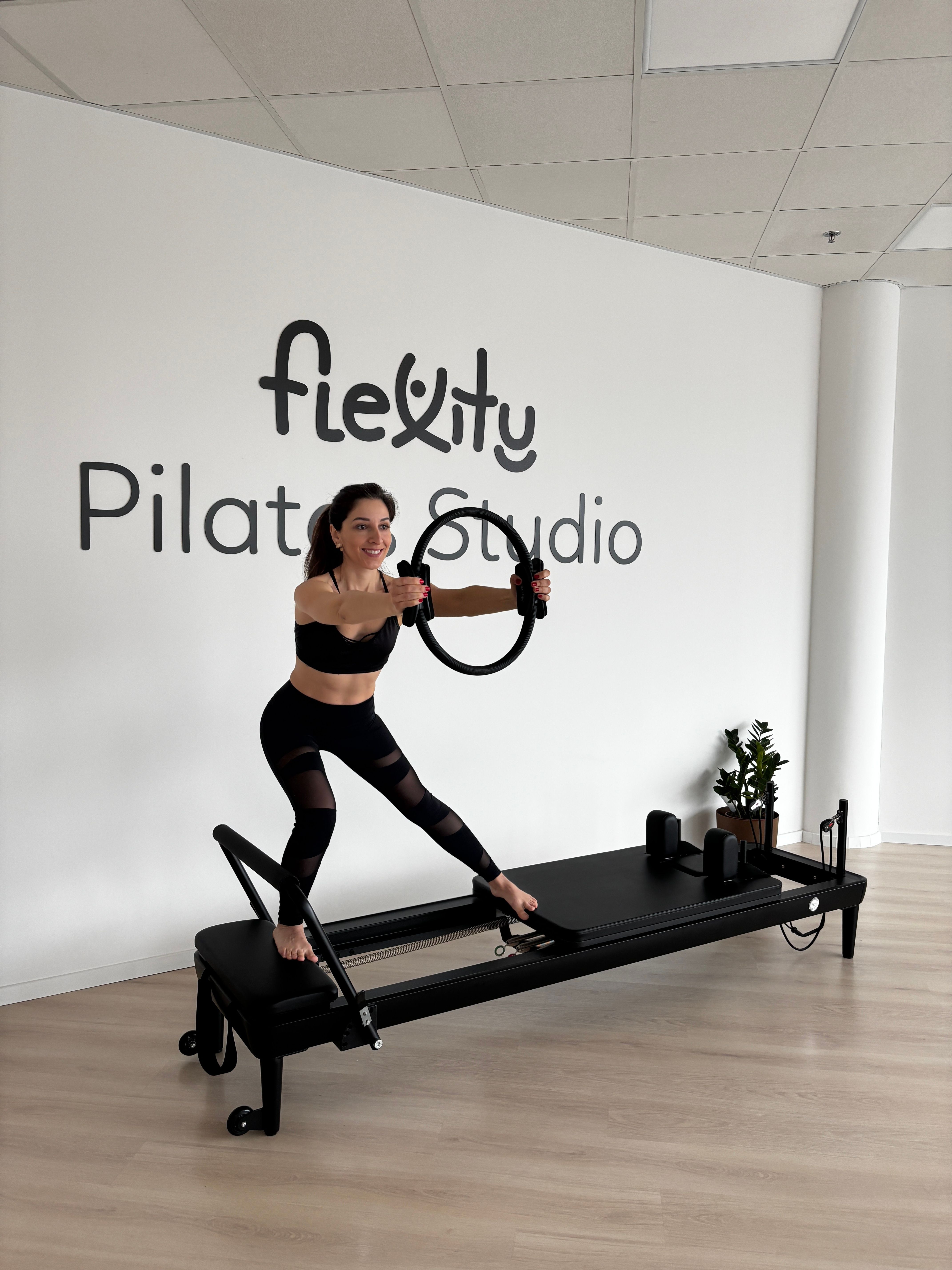
McKenzie signed the lease on H Pilates Haus, her mat Pilates studio in Pueblo, Colorado, with two kids under three at home, a full-time career in real estate, and no idea which booking software to use. She did what every first-time owner does.
"I was Googling and doing as much research as I could as far as booking platforms go, because there's so many," she says.

The pricing is what kept stopping her. Every platform advertised a number that initially looked reasonable, then charged separately for the website, the marketing emails, and the app.
For small studio owners, the decision is which software does everything you need at a price you can plan around, without needing someone whose full-time role is running the booking system. Here's what to look for, and the four platforms worth comparing.
Most Pilates studio owners start their search at Mindbody, because it's the software most of the studios they go to seem to use. Then they open the pricing page, calculate the pricing with the add-ons, and wonder if running a five-reformer studio really requires a system built for franchises.
Short answer
Small Pilates studios (a few reformers in one space, one or two instructors, and an owner handling all the admin) need software that's quick to set up and easy to train a teacher on, includes a website and marketing tools without add-ons, and comes with real onboarding support. OfferingTree, Momence, TeamUp, and Arketa are the four platforms most worth comparing at this size. OfferingTree starts at $100 a month on an annual plan with no added transaction fees.
In this article:
- What counts as a small Pilates studio?
- What software features actually matter at this size
- Can you run a small Pilates studio on a booking-only tool?
- Four platforms worth considering
- How one first-time owner chose
- Questions small studio owners ask
Here's how the four compare before we get into the details:
| Platform | Best for | Starting price | Website included | Watch out for |
|---|---|---|---|---|
| OfferingTree | All-in-one setup with support | $100/mo (annual) | Yes, built-in builder | Fewer advanced customizations than enterprise tools |
| Momence | Modern, polished interface | Quote-based | No | Add-ons stack quickly; total cost is hard to predict |
| TeamUp | Studios staying under 100 members | ~$119/mo | No | Price rises with your member count |
| Arketa | Hybrid studios with on-demand video | $49/mo (one user) | Yes | Published plans cap at one team member |
What counts as a "small" Pilates studio?
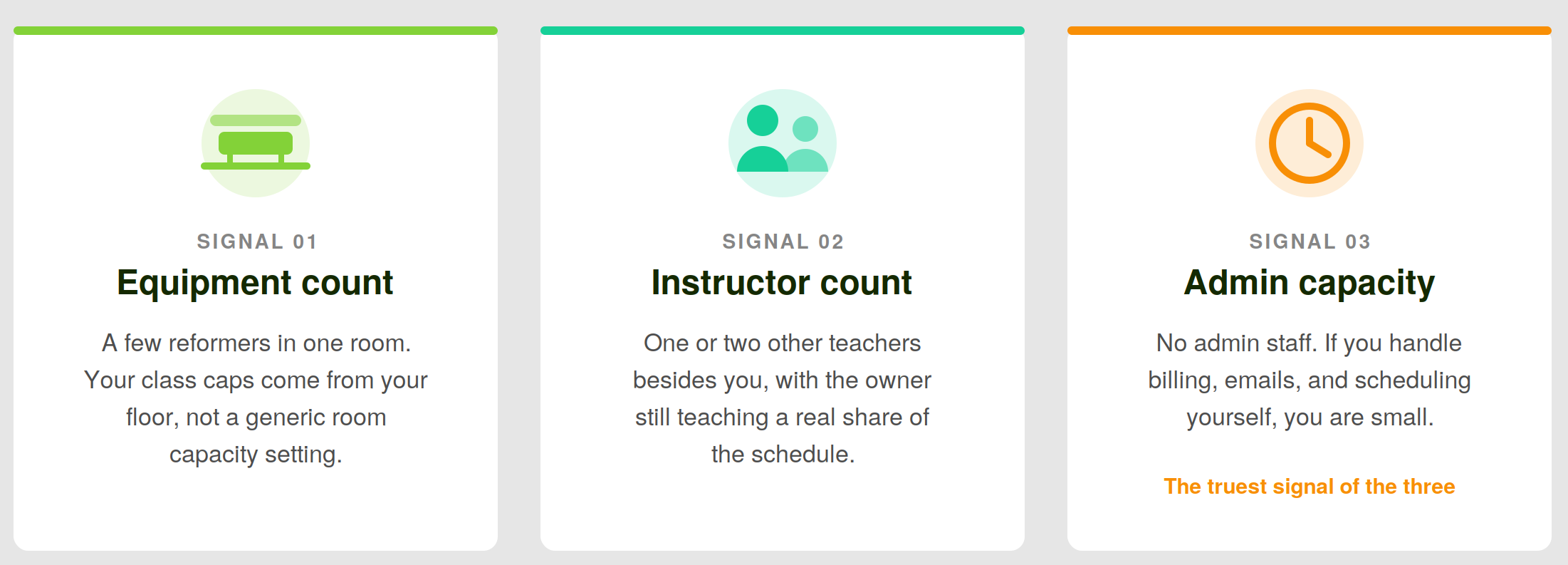
There's no official cutoff, but three signals tell you where you sit.
Equipment count. A few reformers in one room. You know exactly how many, because you paid for each one and you know what the springs cost to replace.
Loren Greenwood caps every class at Cat Cow Pilates at exactly 10, because that's how many reformers she owns. Software that only understands "room capacity" will happily let an eleventh person book a machine that doesn't exist.
Instructor count. One other teacher besides you, covering a meaningful share of the schedule. McKenzie at H Pilates Haus teaches 10 mat classes a week herself, and her second instructor handles the rest. Two or three teachers total is still small.
Admin capacity, which is the truest signal of the three. A small studio can have instructors. What it almost never has is admin staff.
If you're the one reconciling payments at 10pm, answering "can I switch to Thursday?" texts between classes, and writing next month's schedule on your couch, your real constraint is admin hours. Software built for new and independent studios is designed around exactly that.
Plenty of studios stay this size on purpose. Small classes and hands-on correction are the product, and the members who want that will drive past a franchise to get it. Your regulars know you personally,, and that’s the reason they keep coming.
Most studio software assumes scale is the goal and prices accordingly, with per-member tiers, multi-location reporting, and features gated behind plans sized for chains. If staying small is the plan rather than a phase you're passing through, you're paying for an assumption that doesn't apply to you.
What software features matter for small studios
At a franchise, wrestling with the booking software is somebody's whole job. At your studio, it's your Tuesday night that could be spent with your kids (or fur babies!). That changes which features are worth paying for, and which ones are just impressive on a demo call.
Setup you can finish, and training that takes an afternoon
You need to be live in days, not weeks, and you need your other instructor running her own classes without you hovering. McKenzie built her entire studio website herself in about two days, using tutorial videos and one-on-one help from the support team. Handing the platform to her second teacher took one session.
"It was really easy to train her," she says. "I fully trust her with all of it."
Ask any software how long onboarding takes for a studio your size. Vague answers can tell you a lot.
What's included and what costs extra
The advertised price and the real price are different numbers on most platforms. A plan that starts at $100 and charges separately for the website, the email tool, the branded app, and the reporting is a plan that costs $250. When McKenzie compared options, that gap was what ruled several platforms out.
"Momence starts at a hundred, and then everything you want is added onto that," she says. "That's crazy."
Before you compare starting prices, write down the features you'd need on day one and price that bundle on each platform. That’s the comparison you should keep coming back to.
A website that comes with the software
You need a website, and hiring a developer isn't in the budget. Some platforms include a builder; others integrate with a site you build elsewhere. Both work, but the built-in option removes a bill and a second login.
Loren had never built a website before opening Cat Cow Pilates. "It was surprisingly easy if you've never made a website before, to use all the template features and just pop it all in," she says.
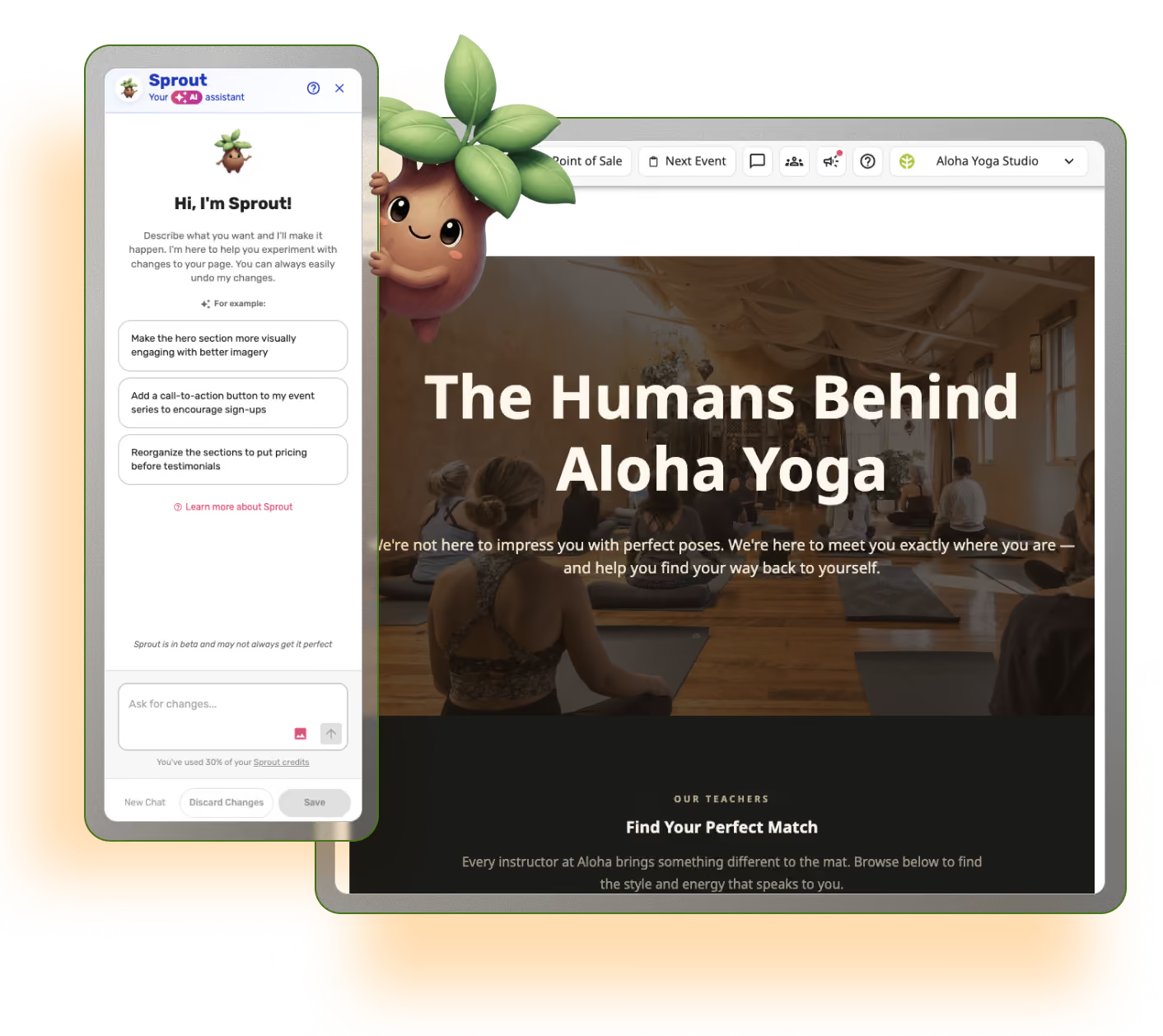
OfferingTree's Sprout AI Page Builder generates pages from a description, which shortens the blank-page problem considerably.
Support that fills the admin gap
You have teachers. You don't have an implementation team. That means the vendor's support team is the closest thing you have to staff, both during setup and at 5:45am when the check-in page won't load and your 6am regulars are already in the parking lot.
Two questions to ask: what does migration look like if you're moving from another system, and how fast does support reply once you're a customer? Loren emails OfferingTree support every week or two from New Zealand, a full day's time zone away from US business hours.
"You're never sort of left wondering if you're going to get a response, you always do," she says.
Support quality is hard to judge from a demo, so it's worth comparing platforms on it directly. We looked at how the major platforms stack up in Pilates studio software with the best customer support.
Pricing that stays predictable as you grow
Flat pricing is easier to plan around than per-member pricing, and both are easier than pricing with a percentage attached. Watch for three things: what the plan costs at your current size, what it costs at the size you're aiming for, and whether the platform adds its own transaction fee on top of standard card processing.
That last one is easy to miss and hard to escape. A 3% platform fee on top of Stripe's standard rate scales with every dollar you bring in, which means it costs you most in the months you're doing best. OfferingTree charges 0% in added transaction fees on Studio plans.
Marketing automations that keep members from drifting
Ask experienced owners why studios close and you'll hear the same answer: sign-ups were fine, month three was not. Filling classes gets all the attention, but keeping people is where the business is actually won or lost.
A few automations do most of that work:
- Intro pack sequences that follow up without you writing the email
- Waitlists that notify the next person and fill the empty spot before class starts
- Memberships on auto-pay with a card on file
- Late-cancellation policies the system enforces so you don't have to have the conversation
The alternative is what most owners start out doing: texting the next person on the waitlist while you're setting up springs, then losing track of who you told what. Loren no longer confirms waitlists by hand or emails policies one at a time, and McKenzie's total admin is down to about five hours a month. See marketing automations.
Reporting belongs in the same category. Ask Sprout, available on all OfferingTree plans, answers questions about your business in plain language and schedules the reports you want to see. Asking "which members haven't been in this month?" takes seconds, and catching someone drifting in week three is how you keep them in month four.
Can you run a small Pilates studio on a booking-only tool?
Sometimes, yes. If you're teaching a handful of classes in rented space, selling single sessions or simple packs, and not running memberships, a scheduling tool like Acuity or Calendly at around $20 a month is a reasonable place to start. Plenty of instructors do exactly this, and there's no sense paying for a studio platform before you have a studio.
It stops working at a predictable point. Booking tools don't run memberships with auto-pay, hold a waitlist against a real reformer count, store client notes about injuries or goals, or market to anyone. Adding those back means Acuity plus an email tool plus a website builder plus a spreadsheet, which costs more than an all-in-one platform and puts you back to entering the same client's information in three places.
The practical test: if you're selling memberships, you've outgrown booking-only software. If you're selling class packs to people who book one at a time, you probably haven't yet. Our OfferingTree vs. Acuity comparison breaks the differences down further.
Four platforms worth considering for a small Pilates studio
Broader platforms like WellnessLiving and Mindbody can absolutely run a Pilates studio, but they're built for a different scale of operation, with more locations, more staff, and more add-ons to manage. The four below are sized closer to a studio with a few reformers and a couple of instructors.
All pricing below was verified on each company's own pricing pages on September 18, 2026. Customer results come from named OfferingTree customers whose full stories are linked.
OfferingTree
Best for owners who want setup, website, marketing, and support in one place at a price they can plan around.
Studio plans start at $100 a month on an annual plan (Studio Starter), with Studio Grow at $150 and Studio Max at $225. The website builder, email marketing, memberships, and reporting are included rather than sold separately, and studio plans carry 0% in added transaction fees beyond standard card processing.
McKenzie's all-in cost at H Pilates Haus is about $100 a month, with classes at 85% capacity within a few months of opening and admin around five hours a month.
The tradeoff: OfferingTree is built for independent studios, so if you need enterprise customization or multi-location franchise reporting, you'll find fewer knobs to turn than in a system priced for chains.
Momence
Best for studios that want a modern, polished client-facing experience and have room in the budget for it.
Momence's interface is genuinely nice, and studios that care about how the booking flow looks to members tend to like it. Pricing is where small studios get caught. Published rates vary by source, add-ons stack on top of the base plan, and the total is hard to predict before you talk to sales. McKenzie's experience researching it is the common one: the entry price looked fine until she added up what she'd actually need.
For a detailed feature and pricing comparison, see our Momence alternative page.
TeamUp
Best for studios confident they'll stay under 100 active members.
TeamUp prices by active member count, starting around $119 a month for up to 100 members. It's a well-built platform with a loyal user base, and at a fixed small size the math is fine.
The tradeoff shows up if you grow. Loren went from about 80 members to 120 in two years and is aiming for 200, and on a per-member model that growth raises your software bill every year. Price the plan at the size you're targeting, not the size you're opening at.
TeamUp also doesn't include a website builder, so budget for a site separately.
Arketa
Best for hybrid studios selling on-demand video alongside in-person classes.
Arketa's on-demand library is the strongest of the four, and every published plan includes unlimited video hosting. If a meaningful share of your revenue comes from recorded classes, that's a real advantage.
The catch is specific and worth knowing before you get attached: Arketa's published Individual plans ($49 to $124 a month, billed annually) are limited to one team member. The moment you add your second instructor, you need a Studio plan, and Studio pricing is quote-only. Individual plans also add a 3% Arketa transaction fee on top of standard Stripe processing.
Our Arketa alternative page has the full comparison.
What it looked like for H Pilates Haus
Two things decided it for McKenzie. The built-in website builder meant she didn't have to manage a site and a booking system separately, and the pricing was one number instead of a base plan plus a list of extras.
She built the site herself in about two days, with no background in web design. Her second instructor learned the platform in a single session. Within a few months, classes were running at 85% capacity and admin had settled to roughly five hours a month.
That last number is what changed the business. She's now planning on-demand courses, reformer equipment, and private events, the kinds of decisions there's only room for when the day-to-day runs itself.
"Owning a business is a little bit scary," she says. "Taking the load off, even generating reports at the end of the month, makes it not as scary."
Questions small studio owners ask
Do I need a separate website and booking system? No. Several platforms include a website builder that connects directly to your class schedule, so members book from your own site. Running them separately works too, but it means two subscriptions and two logins, and you'll need to keep the schedule synced between them.
How long does it take to set up studio software with no tech background? Plan for a few days of focused work. McKenzie built her full site and schedule in about two days using tutorial videos and one-on-one support, with no prior experience choosing business software. Migrating from an existing platform takes longer, and most vendors offer help with it.
Which platforms charge by the member, and what happens as I grow? Most don't. OfferingTree, Momence, and Arketa price by plan tier, so adding members doesn't change your bill on its own. TeamUp is the exception on this shortlist: it prices by active member count, starting at $119 a month for up to 100 members and rising from there. Check which model a platform uses before you commit, and if it's per-member, price it at the size you're aiming for rather than the size you're opening at.
How hard is it to switch platforms later? It can be manageable, and easier if you ask about it upfront. Look for a vendor that imports your client list, memberships, and payment details for you rather than handing you a spreadsheet template. Switching is most disruptive around billing, so time it between membership cycles.
How can a small studio reduce last-minute cancellations and empty spots? Automated waitlists fill the spot without you doing anything: someone cancels, the next person is notified, the class stays full. Pair that with a late-cancellation policy the software enforces automatically, so the rule applies evenly and you never have to argue it in the lobby.
Which software features actually help with member retention? Memberships on auto-pay with a card on file, automated follow-up sequences for new members and intro packs, and reporting that shows you who has stopped coming. Retention breaks down in months two and three, so the feature that matters most is the one that tells you someone's drifting while there's still time to reach out.
Choosing something you won't have to replace
The best small Pilates studio software is the one with the features you use everyday, at a price you can plan around. The right software is the one you stop thinking about.
If that sounds like you, OfferingTree includes the website, the booking, the memberships, and the marketing in one plan starting at $100 a month, with a support team that answers.
Loren, two years and 40 members past her own version of this decision, describes her mornings now like this:
"I don't really have to think about anything. I just arrive and the right people are there, and I check them in, and it's easy."
See OfferingTree in action
Scheduling, payments, your website and email marketing in one place, built for wellness businesses.
Start a free trialSee OfferingTree in action
One platform for scheduling, payments, your website and email marketing - built for wellness businesses, priced for them too.
Start a free trialMore from the Blog

Top rated business software for Pilates studios
The business software Pilates studios rate highest on Capterra and G2. Seven platforms, every score dated and shown with the review count behind it.

The best barre studio software in 2026
Trying to figure out what barre studio software is best for your and your unique barre studio shouldn’t be as big of a hassle as it is. Websites obfuscate their features and prices, and don’t give you an easy answer upfront. We made this comparison guide to help you look at your options with the facts laid out. We opened each vendor's own pricing page to help put everything side-by-side for you to compare.
Best gym management software for independent gyms: top 7 platforms
Seven gym platforms compared on what they actually cost. Real prices from each vendor’s own site, plus the monthly math for a 200-member gym.